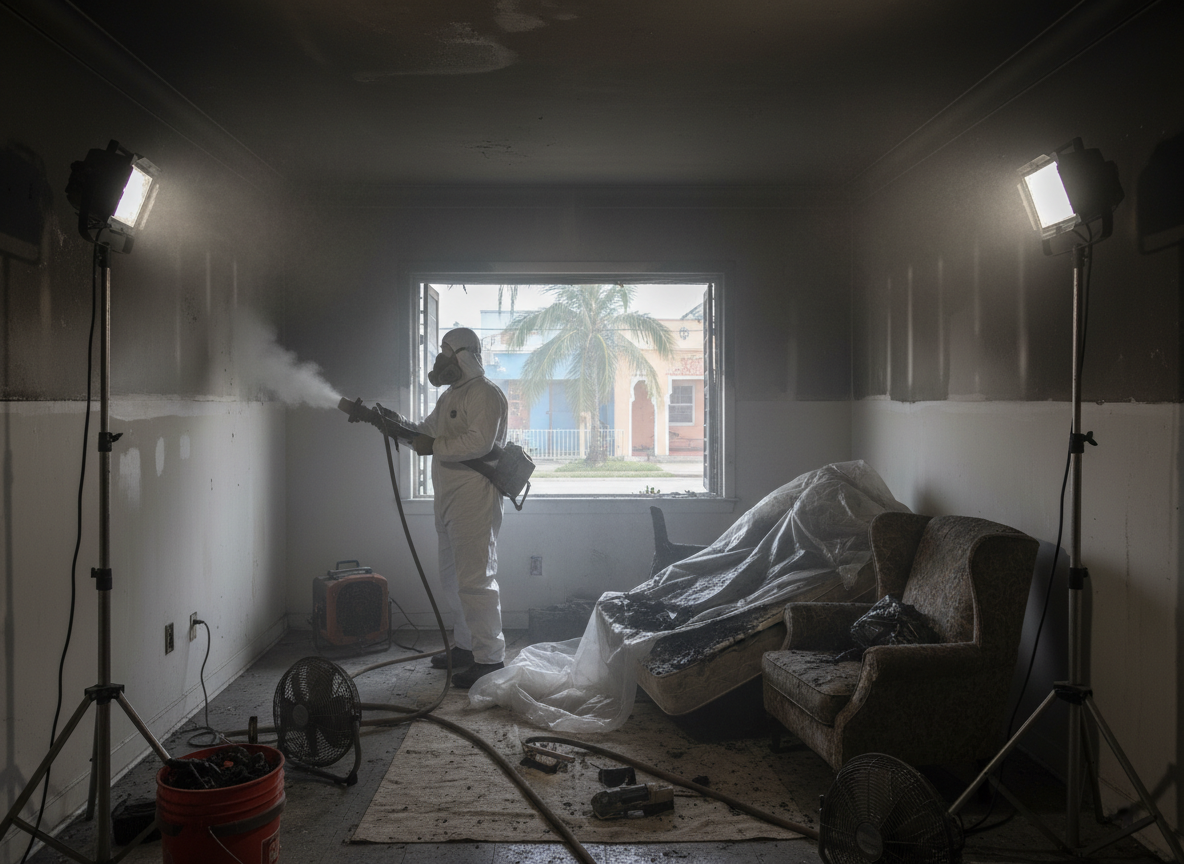
Smoke damage in Opa Locka often involves fine soot that settles into the plaster walls and wooden framing common in homes built before 1960 throughout the Opa-locka Historic District and Magnolia Gardens. The area's tropical monsoon climate brings high humidity that keeps soot particles moist, allowing odors to migrate deeper into insulation and HVAC systems than in drier regions. Technicians must test for pH levels on surfaces before cleaning because alkaline soot from typical residential fires reacts with the lime in older stucco exteriors found near Opa-locka City Hall and Amelia Earhart Park.
Restoration crews working near Opa-locka Airport frequently encounter smoke that travels through shared attic spaces in single-story ranch homes common to the area. These voids trap particles that later release odors when summer humidity spikes. Proper negative air pressure and HEPA filtration are required to prevent cross-contamination into unaffected rooms, especially when properties sit close to the runways where aircraft exhaust already layers additional particulates on roofs.
Miami-Dade building practices from earlier decades left many Opa Locka homes with unsealed ductwork that pulls smoke throughout the structure during a fire event. Restoration includes removing and replacing affected duct sections rather than simple cleaning when soot has bonded to interior fiberglass lining. Homeowners in neighborhoods bordering Hialeah and Miami Lakes often discover secondary damage weeks later when monsoon rains raise indoor moisture and reactivate hidden odors.
Final verification after smoke damage restoration requires both visual inspection and odor testing with an olfactory meter because residual smells in humid conditions can reappear once air conditioning cycles. Properties near the airport face added challenges from constant vibration that can loosen settled soot from ceiling cavities long after initial cleaning.
Technician insight
In Opa Locka, the thing that catches most people out with smoke damage restoration is how the high humidity from our tropical monsoon climate drives soot deeper into the unsealed plaster and lath found in pre-1960 homes around the historic district and Magnolia Gardens. Homeowners often try wiping surfaces themselves and only spread the alkaline residue, which then reacts with moisture from afternoon storms and reactivates odors weeks later.
Historic District Home After Kitchen Fire
Soot from a kitchen fire traveled through unsealed attic spaces into bedrooms of a 1950s home near Opa-locka City Hall. We found heavy residue inside original plaster walls and ductwork. Negative air machines isolated the areas while we cleaned surfaces and treated the HVAC. Odors were eliminated before the next humid front moved through.
How it works
- 1
Initial Assessment
Inspect all affected rooms, test surfaces for soot pH, and map odor pathways through attics and ducts common in Opa Locka construction.
- 2
Containment And Ventilation
Set up negative air machines with HEPA filters to isolate smoke from clean areas while protecting nearby properties in dense Magnolia Gardens blocks.
- 3
Soot Removal
Apply pH-adjusted cleaners to walls, ceilings, and contents, followed by extraction of embedded particles from porous materials.
- 4
Odor Neutralization
Use thermal fogging or hydroxyl generators to break down smoke molecules trapped in humid conditions typical of Miami-Dade summers.
- 5
Final Clearance
Conduct visual checks and odor testing before returning the property, confirming no re-soiling risk from local humidity.
Pricing
Cost depends on square footage affected, depth of soot in older construction, and whether HVAC or attic cleaning is required.